Introduction: Rethinking Onboarding for Day-One Readiness
I’ve lived the onboarding fire drill: scattered emails, last-minute laptop scrambles, and managers asking, “Do they have access yet?” It’s stressful, slow, and error-prone. The turning point came when we stopped treating onboarding as a series of favors and started running it as a system—clear owners, measurable outcomes, and automation where it counts.
Onboarding is a cross-functional system—measurable, automated, and built for day-one productivity. Make the HRIS (Human Resources Information System) the orchestrator so devices, accounts, and least-privilege access align automatically to role and location. Align KPIs (Key Performance Indicators)—time-to-productive, first-week SLAs (Service Level Agreements), and access accuracy—with live visibility for HR, IT, and managers. Harden security by integrating IAM (Identity and Access Management), MDM (Mobile Device Management), and ITSM (IT Service Management) to enforce controls, capture audits, and revoke access as roles change.
Unpacking HRIS Onboarding Automation: From Chaos to Control
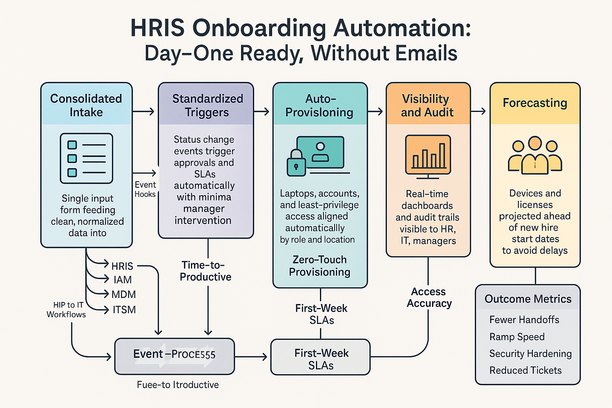
HRIS onboarding automation turns scattered emails into predictable, compliant flows. When roles drive approvals and provisioning, day-one readiness becomes routine—not a fire drill.
- Consolidated intake: One canonical form flows to HRIS, IAM (Identity and Access Management), MDM (Mobile Device Management), and ITSM (IT Service Management)—no rekeying; clean attributes.
- Standardized triggers: Status changes launch dependencies and SLAs (Service Level Agreements); managers approve once.
- Auto-provisioning: Laptops, accounts, and access align to role and location; least-privilege by default.
- Visibility and audit: Real-time status and audit trails reduce escalations and surprises.
- Forecasting: License and device needs are projected from start dates to avoid rush orders and delays.
Result: fewer handoffs, tighter security, and faster ramp—without more headcount.
Mastering Auto-Provisioning: Gear, Access, and Tasks Without Email
Zero-touch provisioning assigns gear, apps, and permissions before day one—no inbox ping-pong. New hires sign in and produce in minutes.
- Identity-first: HRIS and IAM map roles to auto-create accounts and least-privilege access.
- Gear and licenses: Forecast from start dates; MDM ships pre-enrolled laptops; software seats land before day one.
- Tasks sans email: Nudges arrive in Slack or Teams; manager approvals run with SLAs (Service Level Agreements); one status view keeps everyone aligned.
- Control and audit: JML (Joiner–Mover–Leaver) automation, timed access, and complete logs support SOC 2 (System and Organization Controls 2) and internal audits.
Net effect: faster ramp, fewer tickets, tighter security, and more leadership time back.
Bridging the HR to IT Handoff: Secure, Scalable, and Seamless Workflows
Day-one readiness succeeds or stalls at the HR-to-IT handoff. Link HRIS milestones to event-driven IT actions for secure, scalable onboarding—without emails.
- Role-and-location models: Devices, accounts, and spaces auto-provision with approvals logged and least privilege enforced.
- Event hooks: HRIS changes drive MDM, IAM, and ITSM actions; access updates and revocation mirror job changes.
- Normalized data: Clean attributes become the source of truth; leaders see status, exceptions, and audits at a glance.
- Proactive forecasting: Gear and licenses are planned before start dates to cut delays, costs, and IT context switching.
Outcome: fewer handoffs, faster productivity, and lower risk.
Finding Your Practical Playbook: Stay Ahead with Impruver University
If you want vendor-neutral clarity and operating patterns, the Lyaxis Newsletter distills the no-email blueprint into brief, practical reads. When you’re ready for field-tested templates and deeper dives, Impruver University offers a pragmatic playbook you can adapt to your environment.
Explore the newsletter: Lyaxis Newsletter
Get the deeper playbook: Impruver University