I’ve lost count of the late nights I’ve spent untangling “helpful” Zapier automations that had quietly become expensive, noisy, and brittle. The breakthrough didn’t come from buying new tools—it came from cleaning up what we already had. By trimming chatter, adding a few guardrails, and making failures visible, we cut task volume by nearly half, stabilized our data, and finally trusted our automations again. If you’ve felt the same pain, this guide distills the patterns that turned our Zaps (Zapier’s automated workflows) into a quiet, scalable backbone.
Introduction: Why Zapier Cleanup Unlocks Scalable, Low-Cost Automations
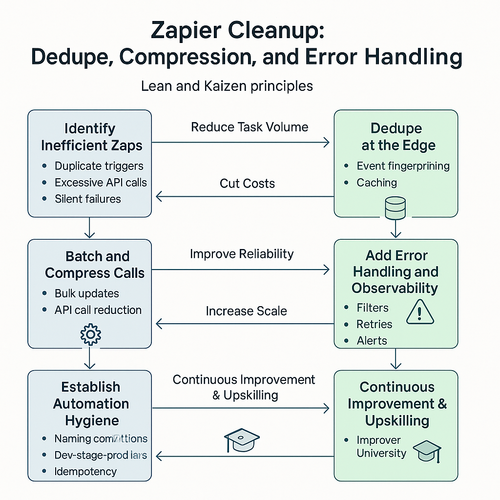
Zapier cleanup cuts cost and brittleness while boosting reliability. Trim chatter and harden flows to create scale headroom without new tools.
- Dedupe at the edge: stop double-fired forms/webhooks so one lead equals one task. A webhook is a server-sent HTTP callback that posts data into your Zap.
- Compress calls: batch updates and use Formatter/Code to collapse lookups, reducing API (application programming interface) roundtrips.
- Add error traps: filters, retries, and alerts turn silent failures into visible fixes.
- Improve observability: clear naming and IDs (identifiers) make debugging seconds, not hours.
Result: lower bills, cleaner data, and automations that compound value.
Diagnosing Chatty and Fragile Zaps: The Hidden Costs of Inefficiency
Chatty, fragile Zaps quietly tax margins. Map symptoms to measurable causes so you can fix the right thing first.
- Spiking task counts? Likely duplicate triggers or broad polling. Consolidate triggers, prefer webhooks, and set dedupe keys so repeat events collapse into a single run.
- Slow runs and throttling? Redundant searches and loops cause delays and rate-limit hits. Prefer upserts (update-or-insert), batching/compression, and modest delays to smooth bursts.
- Duplicates and messy CRM notes? Missing idempotency is to blame. In a CRM (customer relationship management) system, use external IDs, unique keys, and change-only filters so the same event processed twice yields the same final result.
- Silent failures? No retries or alerts. Add error paths, exponential backoff, and Slack or email alerts with context.
Pinpoint hotspots and quantify savings first; cleaner Zaps cut costs and free leadership to focus on growth.
Smart Strategies to Optimize Zaps: Deduplication, Compression, and Error Handling
Under load, chatty Zaps inflate costs and erode data integrity. Make them lean and predictable with a few high-leverage moves.
- Deduplicate at the edge: fingerprint events, cache recent IDs (identifiers), and drop replays before any fan‑out.
- Batch and compress: send arrays to bulk endpoints, replace per‑event alerts with digests, and trim payloads to cut API calls.
- Build calm failure paths: use exponential retries, dead‑letter review queues (a holding area for failed records), per‑record queues to avoid race conditions, and correlation IDs (a unique identifier that ties related events together) for fast audits.
For deeper patterns and real-world configs, explore the Lyaxis newsletter: https://lyaxis.com/category/newsletter/
Establishing Automation Hygiene: Standards for Reliable, Scalable Workflows
As Zaps multiply, inconsistency turns into cost, duplicates, and outages. Light hygiene makes scale predictable.
- Consistent names: use a convention like system.domain.action.vX, and assign clear owners to kill “mystery” Zaps and speed audits.
- Dev–stage–prod lanes: separate development, staging, and production with canary toggles (turn features on for a small subset first) and fast rollback to stop risky live edits.
- Idempotency and dedupe: enforce unique keys at triggers, retries with backoff, and dead-letter alerts to absorb spikes safely.
- Traceability and limits: add trace IDs (identifiers that follow a transaction end-to-end), rate‑limit guards, and batching/compression to cut 30–60% of tasks and reveal root causes quickly.
The payoff is durable: fewer tasks, cleaner data, calmer operations.
From Firefighting to Freedom: Ongoing Insights and Upskilling with Impruver University
Trade late-night firefights for confident iteration. Pair ongoing field insights with practical upskilling so Zapier becomes a quiet backbone, not a source of surprise bills.
- Kill duplicates at the source: harden triggers, add dedupe keys, and merge chatter before it fans out.
- Compress flows: push lookups upstream, batch via webhooks or Paths, and cache results to cut API calls.
- Build in safety: retries, alerts, and dead‑letter steps catch silent failures before customers feel them.
For patterns and pitfalls, skim the Lyaxis newsletter: https://lyaxis.com/category/newsletter/. And when upskilling makes sense, Impruver University’s bite-size lessons turn relief into routine—costs drop, reliability rises, and your team levels up. Start here: https://university.impruver.com/?aff=lyaxis (use code “15off”).