Introduction: Crafting a Lean Daily Management System That Lasts
After years of watching daily meetings drift into status theater and dashboards go stale, I learned that what endures is simple: a steady rhythm, visible signals, and real ownership at the frontline. Daily management is the backbone of flow—simple routines, clear signals, and frontline ownership that compound gains and give leaders time back. If you want quick, practical patterns, the Lyaxis newsletter shares what sticks. When you’re ready to turn those patterns into repeatable wins, Impruver University provides the drills to make it real. Throughput up, noise down.
Mastering the Daily Huddle Cadence: From Status Updates to Real Action
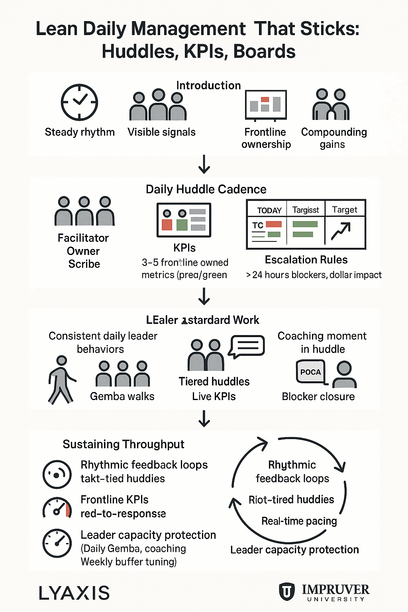
Your huddle should turn yesterday’s learning into today’s throughput. When it becomes status theater, flow stalls. Run a crisp 10–15 minute huddle focused on today’s plan, yesterday’s misses, and unblockers—then end with names and deadlines.
- Cadence: 10–12 minutes at start of day; close with who/when. If it runs long, you’re solving at the wrong tier.
- Roles: Facilitator guards pace; owner sets one priority; scribe updates the board. Rotate to build ownership.
- KPIs (Key Performance Indicators): Keep 3–5 frontline-owned measures (plan vs actual, First-Pass Yield (FPY), on-time delivery (OTD), blocker age). Red is a trigger for action, not blame.
- Escalation: If a blocker lasts more than 24 hours or exceeds a set dollar impact, escalate to tier‑2 (the next management tier) within an hour.
Choosing the Right KPIs and Visual Boards to Boost Frontline Accountability
Accountability sticks when people see cause, effect, and the next move. Pick a few KPIs tied to customer value, and make them visible where the work happens.
- Focus on the vital few: Make 3–5 leading KPIs visible at the point of use, each with a single owner; aim to close gaps before noon.
- Pair lagging with leading: Match one lagging result (for example, OTD—on‑time delivery, or defect escapes) with 2–3 leading drivers (for example, FPY—First‑Pass Yield, cycle adherence, tickets closed in under 24 hours).
- Design boards for action: Show today vs target, trend, owner, and the next experiment. If it’s red, ask: what did we learn today?
- Keep boards alive: Have operators update in real time; if the data isn’t current, treat the system as broken and fix it.
- Coach in the huddle: Use 10 minutes to close gaps; leaders coach one PDCA (Plan‑Do‑Check‑Act) and clear one blocker.
Fewer, clearer signals turn pressure into progress—freeing leadership time and lifting throughput. The Lyaxis newsletter distills patterns; Impruver University gives the drills.
Leader Standard Work: Embedding Consistency to Reduce Firefighting
Leader Standard Work turns intent into rhythm. Consistent habits cut firefighting and raise flow.
- Same-time gemba: Short, at-the-same-time gemba walks (the “real place” where work is done) catch yesterday’s misses and today’s risks before they spread.
- Tiered alignment: Run 10–15 minute tiered huddles to align on constraints; ensure each metric has an owner and a clear action.
- Live flow metrics: Keep 3–5 flow KPIs on a live board at the point of work; when a signal turns red, leaders coach and close at least one problem daily.
- Standardize leader time: Short gemba, fast escalation, and coach—don’t firefight.
Consistency buys back executive time and can unlock 15%+ throughput in 90 days.
Sustaining Throughput and Leadership Time: Building a Self-Correcting Operational Rhythm
Sustained throughput comes from rhythm, not heroics. Build feedback loops that correct drift early and protect both maker and manager time.
- Takt‑tied huddle: Hold a 10‑minute huddle tied to takt time (the pace needed to meet customer demand): review yesterday’s blockers, today’s buffer risks, owner, and deadline—no status theater.
- Frontline signals: Show 3–5 frontline KPIs at the point of use (throughput, FPY—First‑Pass Yield, WIP age—how long Work‑In‑Progress has been active) with clear red‑to‑response rules.
- Real‑time pacing: Keep boards current with pacing and buffer signals so teams can correct early.
- Protect leader capacity: Standardize daily gemba and coaching, plus a 30‑minute weekly to tune buffers and protect thinking time.
Curious how it works in practice? Browse the patterns in the Lyaxis newsletter, then test and scale through Impruver University. Result: steadier flow, fewer fires, more headspace.