Introduction
I’ve scaled teams that were busy everywhere yet late where it mattered. The turning point came when we stopped polishing every station and centered the single constraint—the real bottleneck throttling delivery. Once we aligned work release, metrics, and habits to that one point, throughput jumped, lead times stabilized, and the fires finally cooled. This article distills what’s worked repeatedly: the Theory of Constraints, or TOC (Theory of Constraints), the Five Focusing Steps, practical buffer management with DBR (Drum‑Buffer‑Rope), and simple team practices that free leadership time.
Unlocking Growth: Why the True Bottleneck Holds the Key to Scale
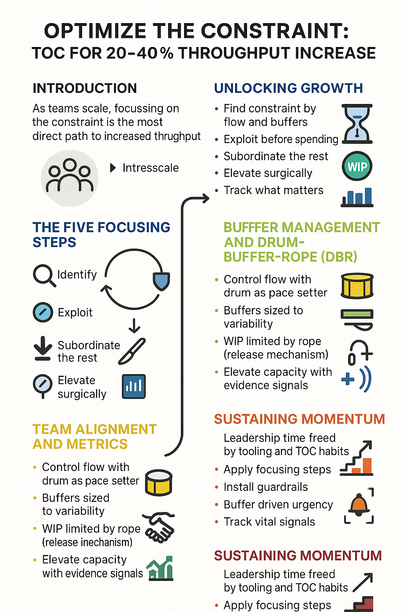
Most teams optimize everywhere and still ship late. Throughput jumps when you center the single constraint—the point in your system that governs overall flow.
- Find the constraint by flow and buffers, not utilization: look for the queue that stays “red” and owns lead time. Utilization can mislead; flow signals don’t.
- Exploit before you spend: protect the constraint’s time, cut setups and context switches, and feed only good work.
- Subordinate the rest: apply hard WIP (Work in Progress) limits and set priorities tied to buffer signals so upstream and downstream work supports the constraint.
- Elevate surgically when gains plateau: only add capacity, tooling, or automation once you’ve exploited and subordinated—then recheck the whole system.
- Track what matters: monitor throughput, due‑date hit rate, and buffer health; ignore local efficiency vanity metrics.
Handled this way, teams commonly see 20–40% more throughput with fewer fires.
Mastering the Five Focusing Steps: Pinpoint, Exploit, and Elevate Your Constraint
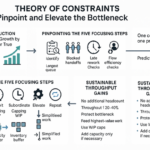
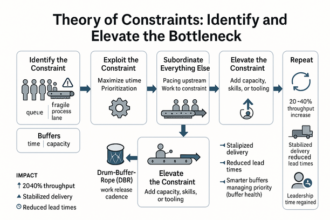
The Five Focusing Steps turn firefighting into flow and help you realize the gains where it counts.
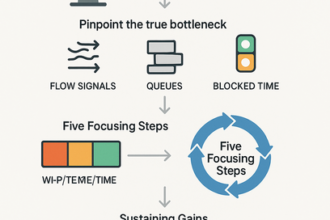
- Identify: pinpoint where WIP (Work in Progress) piles up and due dates slip; prove it with throughput impact, not utilization.
- Exploit: protect uptime, stagger changeovers, and timebox decisions so the constraint never waits.
- Subordinate: cap upstream WIP, reroute talent, and pace flow with simple buffers so everything serves the constraint.
- Elevate: add capacity or targeted automation only where buffer breaches persist—avoid system‑wide chaos.
- Repeat: once the constraint moves, reset buffers, policies, and attention to the new drum.
For reusable cadences and field notes, the Lyaxis newsletter curates patterns you can copy into your team. Browse Lyaxis’ newsletter for predictable delivery tips.
Balancing Throughput and Flow: Practical Buffer Management and Drum-Buffer-Rope Insights
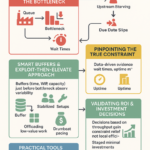
Throughput jumps when variability stops hitting the constraint. DBR (Drum‑Buffer‑Rope) makes flow predictable by pacing to one drum, protecting it with right‑sized buffers, and releasing work only as fast as the system can absorb it.
- Find the real drum: track throughput and buffer signals at the constraint, not utilization everywhere else.
- Size buffers fast: start near half the constraint’s observed variability; tune using buffer penetration signals, not sprawling spreadsheets.
- Limit WIP to the rope: release only what the buffer can absorb to end chronic queues, expediting, and thrash.
- Elevate with evidence: when buffers stay consistently green and the constraint is stable, add capacity at the drum.
Outcome: more predictable flow, shorter lead times, and calmer days.
From Firefighting to Focus: Aligning Teams and Metrics Around Throughput
Firefighting hides the real constraint. Alignment around throughput and flow lets you ship more with the same team.
- Make the constraint visible: identify where work actually slows; protect it and feed it with buffer signals—not heroics.
- Establish explicit handoffs: set WIP (Work in Progress) limits and clear policies so queues shrink and standups become flow decisions.
- Measure what moves cash: focus on throughput, constraint uptime, and buffer health; retire siloed utilization metrics.
- Invest where ROI compounds: elevate the constraint before adding headcount or broad automation. ROI (Return on Investment) is highest where the system is gated.
Teams that do this reliably report 20–40% more throughput and steadier weeks. For steady prompts and field‑tested tweaks, the Lyaxis newsletter keeps them close.
Sustaining Momentum: How Tooling and TOC Principles Free Leadership Time
Leaders don’t need more dashboards; they need protected attention. Just‑enough tooling and TOC (Theory of Constraints) habits focus everyone on the single constraint, unlocking gains without ballooning headcount.
- Apply the Five Focusing Steps: identify one constraint and subordinate the rest so effort concentrates where it pays.
- Use lightweight guardrails: visual cues, small automations, and policies that block unplanned work shield maker time.
- Let buffer signals drive urgency: expedite only when the constraint’s buffer says so—and wait when it doesn’t.
- Track the few vital signals: throughput, lead time, and buffer health beat siloed utilization every day.
Want breathing room and a faster path to predictable flow? The Impruver TOC playbook (code 15off) can accelerate adoption while you keep the team focused. Net: predictable flow, fewer fires, clearer ROI (Return on Investment).