Introduction: Unlocking 15% Cloud Spend Savings with Smarter FinOps
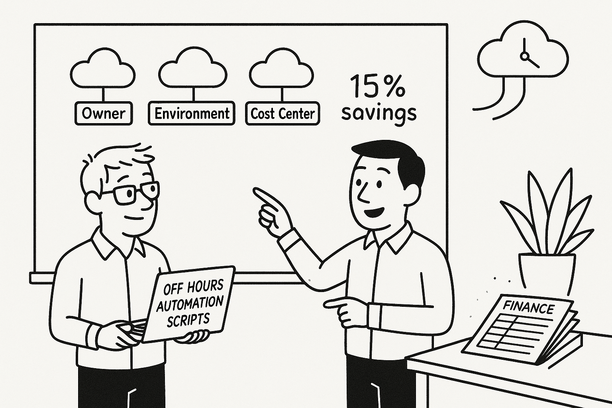
In my first month leading FinOps (Financial Operations) at a fast-growing SaaS company, we pulled back roughly 15% of our cloud spend in weeks—without touching production—by fixing ownership and automating the obvious. We started simple: make sure everything had a clear owner, align environments, and let lightweight automation handle off-hours shutdowns. Finance finally saw the same numbers engineering did, and leadership stopped chasing spreadsheets. If you want de‑risked patterns and pragmatic checklists, the Lyaxis newsletter maps the playbooks I wish I’d had from day one.
Why Tagging Compliance Is Your Linchpin for Cost Control Success
Tagging is the switch that turns FinOps from reports into results. At 90%+ tag compliance, leaders commonly unlock around 15% savings with zero production risk because allocation, ownership, and safe automation all start working.
- Adopt a minimal, practical tag schema — Start with Owner, Environment, and Cost Center; add SLA (Service Level Agreement) where risk-aware automation matters.
- Target >90% tag coverage — High compliance unlocks accurate chargeback, dependable dashboards, and safe shutdown eligibility.
- Make compliance effortless — Enforce tags in CI/CD (Continuous Integration/Continuous Delivery), auto-fill sensible defaults, and time-box exceptions so engineers aren’t blocked.
- Let policies and schedules read tags — Shut down non-production after hours and quarantine idle waste using the tags as intent signals.
- Close the loop where everyone can see it — Track owners, SLAs, actions, and realized savings so finance and engineering share one trusted view.
Automating Idle Resource Shutdowns Without Risking Production
Idle spend is predictable; production risk isn’t. The goal is 10–20% savings through safe, signal-driven automation that respects production boundaries.
- Prefer signal-driven detection over blunt schedules — Use utilization, request rates, and deploy cadence to identify when resources can sleep.
- Add guardrails from day one — Use exemption tags, change-freeze windows, and instant rollback so production stays safe.
- Roll out safely and visibly — Start with canaries, watch SLOs (Service Level Objectives), auto-revert on anomalies, and keep an audit trail.
- Back automation with strong tagging — When owners, SLAs, and environments are >90% complete, automation decisions are reliable and explainable.
- Track actions and outcomes — Log actions, rollbacks, and realized savings for executive visibility and continuous improvement.
Using Monday.com to Centralize Ownership, Track Actions, and Prove Savings
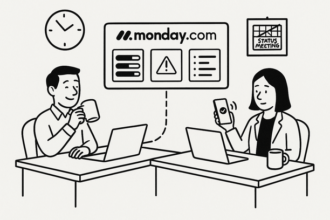
Put Monday.com at the center of FinOps to turn insight into action—and proof. Expect 10–20% savings without risking production when owners, SLAs, and evidence live in one place. Every cost item has an owner; SLAs prevent drift. Tagging rises past 90% by auto-assigning gaps and surfacing blockers. Evidence links—Cost Explorer, logs, and pull requests (PRs)—quantify savings by team and project. An executive dashboard shows actions due, savings realized, and risk, while automations close the loop for dependable follow‑through and clearer return on investment (ROI).
- One source of truth — A single board for actions, owners, exceptions, and verified savings so finance and engineering see the same numbers.
- Evidence-backed decisions — Attach Cost Explorer screenshots, logs, and PRs to quantify impact by team and project.
- Executive-ready dashboards — Track actions due, realized savings, and risk posture at a glance.
- Automation that sticks — Tie off-hours shutdowns to tags, record change approvals, and nudge owners before exceptions expire.
- Closed-loop attribution — Attribute savings to teams, alert on drift, and retire spreadsheet chases.
If you want a ready-to-use control room, you can start a board quickly here: Monday.com.
Building Scalable, Lightweight FinOps Governance That Engineering Embraces
FinOps scales when engineers prefer it. Small policies, paved roads, and transparent scorecards routinely cut 10–20% without touching production—because they reward good defaults instead of policing edge cases.
- Paved roads, not gates — Make a minimal tag schema a build-time must; >90% compliance follows because it unlocks automation and eliminates rework.
- Transparent scorecards — Publish coverage, idle-stop eligibility, and realized savings so progress is visible and teams are recognized.
- Safe-by-default automation — Use tags to trigger off-hours shutdowns and rightsizing with clear production exemptions.
- Federated ownership — Product teams hold budgets and make changes; a lean core team curates patterns, policy, and tooling.
- Closed-loop tracking — Keep actions, owners, SLAs, and savings measurable and auditable in Monday.com so wins are provable.
Curious where to start? The Lyaxis newsletter breaks these patterns into short, low-friction playbooks you can run this week.