Introduction: Why Weekly PDCA Is the Game-Changer for Evolving SOPs
I learned the hard way that “set it and forget it” Standard Operating Procedures (SOPs) stall faster than they scale. The moment we shortened our improvement loop to a weekly Plan‑Do‑Check‑Act (PDCA) cadence, the work started meeting reality: problems surfaced earlier, fixes got lighter, and teams stopped treating standards like paperwork and started using them as leverage.
What if SOPs evolved every seven days? Short loops catch drift early and turn small observations into wins. Reality first: frontline notes where the SOP fights reality; a two‑minute note triggers a two‑line change. Governance light: named owner, weekly versioning, audit‑ready traceability—no bureaucracy. Cadence over campaigns: tiny tests beat big‑bang rollouts; you’ll see gains in First Pass Yield (FPY), Overall Equipment Effectiveness (OEE), and lead time. Leader relief: fewer approvals, more coaching; teams view standards as help, not paperwork. Result: cleaner SOPs, faster flow, fewer fires.
Want prompts and rhythm without the fluff? Skim the Lyaxis newsletter for field‑tested nudges and patterns: https://lyaxis.com/category/newsletter/. If you need structured enablement, Impruver University is a simple add (use code 15off): https://university.impruver.com/?aff=lyaxis.
Breaking the Cycle: Overcoming Common Barriers to Kaizen Cadence
Kaizen (continuous improvement) often stalls from friction—murky ownership, slow approvals, and tool sprawl. Light guardrails make improvement easy to start and hard to stop.
- Ownership: Name a single steward per SOP; rotate quarterly to build bench and accountability.
- Approvals: Time‑box consent to 48 hours; default to “try in one area,” escalate only for real risk.
- Tools and cadence: Put the checklist, SOP, and change log on one page where work happens; a 30‑minute weekly PDCA ships one tiny change and one metric.
Curious prompts without commitments? The Lyaxis newsletter offers one nudge a week. For enablement when you’re ready, Impruver University helps (code 15off).
Building a Lightweight, Scalable Weekly PDCA Rhythm That Works
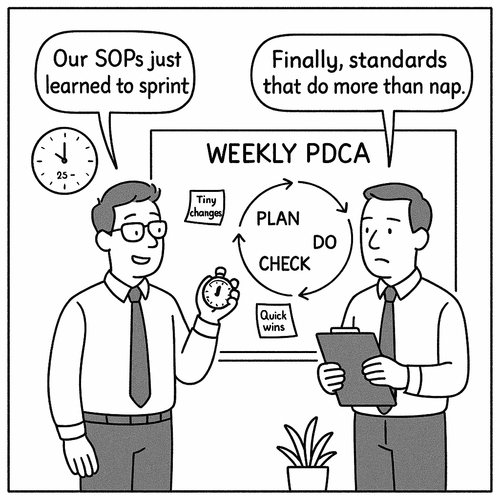
What if improvement took 25 minutes a week? A lightweight weekly PDCA turns SOPs into living standards and gives leaders time back.
- 25‑minute cadence: Review one trend and one blocker per area; commit one micro‑experiment with a clear owner.
- Visible queue: One Kanban of SOP gaps and experiments (WIP ≤3, where WIP means Work In Process), made visible via QR (Quick Response) codes and Slack for hybrid teams.
- Tiny, de‑risked trials: Keep each change to ≤1 hour, complete a compliance pre‑check, have a rollback ready, and measure the shift in FPY/OEE/lead time the next week.
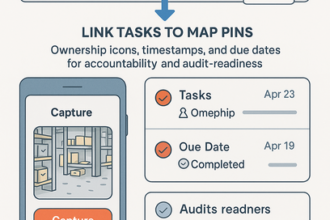
- Simple governance: Record the SOP owner, a revision stamp, and the reason for change; auto‑share updates so no one is surprised.
For copy‑paste patterns that speed setup, the Lyaxis newsletter drops practical prompts. If you want enablement later, Impruver University pairs well (code 15off). Result: fewer fires, faster flow.
Turning SOPs Into Living Standards: Governance, Version Control, and Compliance
Static SOPs breed drift and audit risk; a weekly PDCA cadence makes them living standards with ownership and traceability—without more meetings.
- Decisions at the value stream: Assign a clear owner and an approver of record; make decisions where the work flows, not in a boardroom.
- Version with evidence: Version every update with PDCA‑linked reason codes; evidence becomes automatic rather than a pre‑audit scramble.
- Guardrails over gates: Use pre‑approved change classes, 48‑hour SLAs (Service Level Agreements), and defined rollbacks to keep risk low and speed high.
- Frontline visibility: Frontline edits flow through templates; leaders see FPY/OEE shifts directly in the line.
For de‑risked governance patterns, the Lyaxis newsletter shares clear maps. When you need enablement, Impruver University adds cadence prompts (code 15off). Living standards cut rework and give leaders back hours.
Sustaining Gains Without Burnout: Practical Enablement and Continuous Improvement Support
Lasting gains come from a calm weekly PDCA that keeps SOPs alive—shifting teams from firefights to first‑pass wins.
- Create coaching lanes: Define the owner, coach, and reviewer; 15‑minute huddles unblock tests at the front line.
- Use lightweight automation: Send simple nudges for version checks, before/after capture, and Slack updates—no new system required.
- Make recognition routine: Spotlight small experiments tied to FPY, OEE, or lead time—not paperwork.
- Keep governance simple: Maintain a one‑page change log that maps standards to compliance requirements.
Curious? Browse the Lyaxis newsletter for examples: https://lyaxis.com/category/newsletter/. When you’re ready for structured enablement, Impruver University adds cadence prompts and light governance that scales (use code 15off): https://university.impruver.com/?aff=lyaxis. The payoff: compounding gains without burnout.