Introduction: Unlocking ROI by Prioritizing Backlogs with Cost of Delay
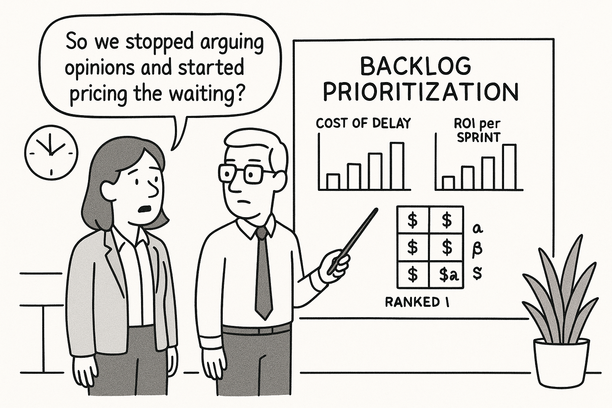
I’ve watched great teams spin for weeks, debating priorities while cash quietly bled out in the background. The turnaround always started the same way: we stopped arguing opinions and priced the waiting. By putting a dollar figure on delay, we aligned in minutes, shipped sooner, and watched the numbers confirm what instinct couldn’t quantify.
Your backlog isn’t a to‑do list; it’s a queue with carrying costs. Cost of Delay (CoD) exposes the fastest cash return, replacing opinion with economics.
- Quantify urgency. If an item is worth $60k/month, a 2‑week slip burns $30k.
- Sequence for ROI (Return on Investment). Rank by CoD divided by duration using Weighted Shortest Job First (WSJF) to maximize payoff per sprint.
- Shrink queues. Cap WIP (Work in Progress) to cut lead time and pull revenue forward 15–30%.
- Align fast. A shared number ends HiPPO (Highest Paid Person’s Opinion) debates and frees leadership hours.
For ongoing decision models, explore the Lyaxis newsletter; when you’re ready to go deeper, consider Impruver University (use code 15off). Takeaway: a value‑first roadmap that lifts ROI and steadies cash flow.
Understanding Queue Economics: How Work Waiting Erodes Value
Work doesn’t just wait in queues—it depreciates. Small delays ripple across teams, stretching lead times and starving cash flow. The good news: a few explicit policies restore flow without more meetings or headcount.
- Cap WIP. Halving items in progress often halves cycle time (Little’s Law), pulling revenue forward.
- Expose flow efficiency. Most items spend 70–90% idle; making wait time vs. work time visible unlocks capacity without hiring.
- Tame variability. Smaller, steadier slices cut queues and risk.
- Prioritize by Cost of Delay/Duration (CD3). Deliver the highest dollars per day first for stronger ROI‑per‑sprint and predictability; CD3 means Cost of Delay divided by duration.
The result is shorter queues, faster cash, and calmer execution—because everyone can see why the next item matters most.
Applying Cost of Delay to Rank Backlogs for Maximum Sprint Impact
Backlogs bloat while value decays in queues. Turn Cost of Delay into a sprint‑ready ranking so the next sprint returns cash faster.
- Quantify CoD. Include revenue impact, cost avoidance, and risk reduction; for example, a 2‑week slip on $120k/month burns roughly $56k.
- Rank with WSJF (Weighted Shortest Job First). Compute CoD ÷ duration; small, high‑CoD items leapfrog and compound ROI.
- Cap WIP to cut queueing loss. Fewer parallel items raise throughput and predictability.
Do this weekly and your roadmap naturally tilts toward faster payback, steadier cash, and clearer trade‑offs.
Sequencing Work to Cut Lead Times and Boost Throughput Without Bureaucracy
Queue economics beat opinions. Sequence by value density—Cost of Delay per week per unit of effort—and risk to lift throughput and ROI per sprint without piling on process.
- Rank by CD3 (Cost of Delay ÷ Duration). For example, $50k/week for 2 weeks outranks $80k/week for 3.
- Shrink batches and cap WIP. Smaller slices shorten waits and accelerate revenue realization.
- Make policies explicit. Cap WIP by class of service: expedite, fixed‑date, standard.
- Clean dependencies early. Sequence to remove blockers and rework before they multiply.
These lightweight rules move value sooner, cut lead times, and reduce the firefighting that drains attention.
Building Shared Economic Clarity: From Leadership Relief to Continuous Improvement
Shared economic language turns prioritization from opinion to relief. Cost of Delay aligns work with cash and risk, making trade‑offs visible and fast.
- Price waiting. A $100k/month feature delayed six weeks defers about $150k; sequence to stop the bleed.
- Rank by CoD ÷ duration. Highest ROI per sprint rises, including small bets that compound quickly.
- Expose queues. Cap WIP to lift throughput and cut lead time without more bureaucracy.
- Make it visible. Put CoD/day (Cost of Delay per day) and age‑of‑work on one chart; a 15‑minute weekly review is enough.
If you want vendor‑neutral patterns you can apply tomorrow, the Lyaxis newsletter distills practical decision models. When you’re ready to deepen practice and coach others, Impruver University offers a structured path (use code 15off). Net: fewer debates, faster cash, more air.