Introduction: Transforming Your Value Stream Map into a Dynamic Kanban Pull System
I used to treat the Value Stream Map (VSM) as a workshop artifact—great for an offsite, forgotten by Monday. The turning point came when we rebuilt the map as a living Kanban pull system. Within a few weeks, escalations dropped, reviews shortened, and lead time fell without asking anyone to work harder. This article distills those lessons so you can move from static diagrams to a steady, predictable flow.
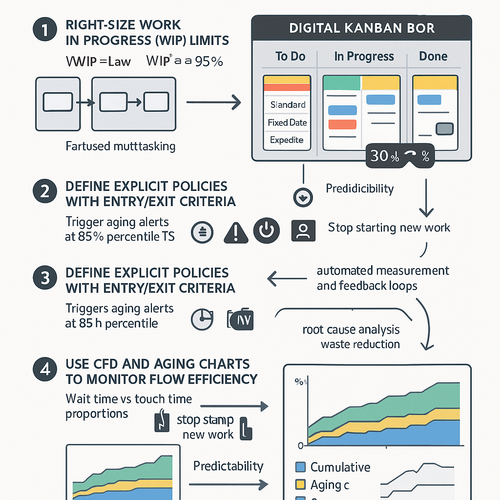
Your Value Stream Map can power a live pull system—not sit in slides. Turn each stage into a Kanban board with clear signals and cadences for sharper visibility and faster feedback. In practice, four moves do most of the work:
- Right-size Work in Progress (WIP) to end multitasking so teams finish sooner and cut lead time by about 30%.
- Use swimlanes to surface demand versus capacity and rebalance before queues swell.
- Define clear Classes of Service (CoS) with explicit policies to stop thrash and queue-jumping.
- Use a Cumulative Flow Diagram (CFD), aging charts, and Service Level Expectations (SLEs) so predictability is measured and status meetings shrink.
Right-Sizing WIP Limits and Defining Classes of Service to Cut Lead Time by 30%
Right-size WIP to real capacity and protect Kanban flow with clear Classes of Service. Done well, teams routinely cut lead time by roughly 30% without overtime.
- Use Little’s Law to set total WIP. Total WIP ≈ throughput × target lead time; adjust WIP so your actual lead time matches your promise.
- Cap each column at 85–95% of capacity to preserve slack. A small buffer absorbs variability and prevents cascading delays.
- Establish Classes of Service (CoS) with explicit capacity reservations. Standard is the default; Fixed Date work reserves 10–15% capacity; Expedite has a single slot and requires clear payback rules.
- Make policies explicit at each step. Define entry/exit criteria, trigger aging alerts at the 85th percentile SLE, and stop starting when WIP caps are hit.
- Watch your Cumulative Flow Diagram (CFD) to detect imbalance. If bands widen, lower WIP, rebalance staffing, or revisit policies before queues spiral.
Leveraging Swimlanes and Explicit Policies to Balance Flow and Reduce Firefighting
Swimlanes and explicit policies convert your VSM into a digital Kanban pull system. Segment work by demand and risk, and make pull rules visible so people can self-serve decisions instead of escalating.
- Segment by demand and risk. Map VSM stages to lanes; route Standard, Fixed Date, and Expedite differently to match their promises.
- Use swimlanes to reveal demand versus capacity early. Bottlenecks surface as lanes swell; rebalance staff or WIP before service levels slip.
- Set clear promises with Classes of Service without allowing queue jumping. Protect Standard flow while honoring true deadlines and rare Expedites.
- Enforce WIP limits per lane to stabilize cycle time. Lane-level caps curb firefighting and make delivery times more consistent.
Tracking Flow Efficiency with Lightweight Metrics for Predictable Delivery
Predictable delivery starts by separating touch time (active work) from wait time (in-queue). Lightweight metrics expose hidden queues without heavy reporting.
- Track flow efficiency to spot waiting waste. If the share of touch time is under about 30%, most work is waiting—tighten WIP and refine policies.
- Monitor Aging WIP against Service Level Expectations (SLEs). Compare days-in-process to your class-of-service SLEs and trigger help before promises slip.
- Use throughput and a simple Cumulative Flow Diagram (CFD) to find constraints. When arrival rates exceed completion rates, rebalance swimlanes or reduce intake.
- Set probabilistic SLEs (e.g., 85th percentile) for credible commitments. Communicate “most items finish within X days” to cut status churn.
A Practical, Low-Friction Path to Implementation and Sustained Improvement
Turn your Value Stream Map into a living digital Kanban that pulls, flows, and predicts—start small, embed daily habits, and sustain with gentle feedback loops.
- Right-size WIP per column to match real capacity and protect flow.
- Use swimlanes and Classes of Service to separate Expedite, Standard, and Fixed Date work, ending priority thrash.
- Set explicit entry/exit, blocker, and replenishment policies so the board replaces most status meetings.
- Review CFD, aging charts, and SLEs weekly to rebalance before bottlenecks spread.
For vendor-neutral patterns and templates to get started quickly, explore the briefs in the Lyaxis newsletter. If you want a structured, deeper dive, the VSM-to-Kanban course from Impruver University covers the end-to-end system, from WIP math to SLEs and policies—check it out at Impruver University (optional code: 15off).