I learned the hard way that averages lie. In my early days running a support desk and later helping a clinic front desk, our plans were built on “typical days” and “average handle time.” Mondays still melted, people skipped breaks, and leaders lived in firefights. The breakthrough was discovering takt time—the simple beat that let us match staffing to real demand, cut queues, and protect team well-being. Once we put work on a shared cadence, our days got calmer in minutes, not months.
Unlocking Service Efficiency: Why Takt Time Matters Beyond Manufacturing
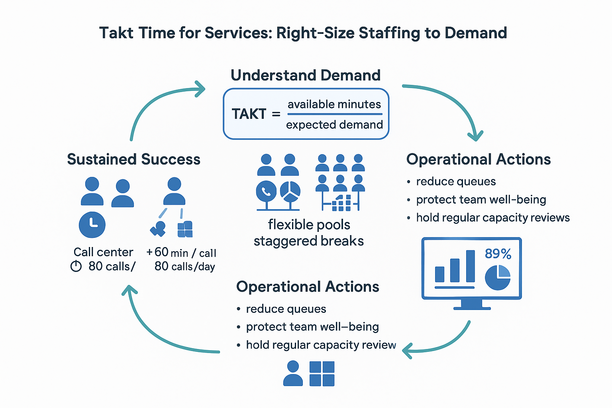
Takt time gives service teams a beat to match staffing to demand, cut queues, and protect well-being. Instead of steering by weekly or monthly averages, you run the day on a cadence leaders can adjust quickly.
When work exceeds the beat, queues form. If your average handle time (AHT, the average time to complete a customer interaction) is longer than takt time, you’ll see backlogs. The fix isn’t always headcount. Improve routing, cross-train so capacity can flex, or trim rework and handoffs to bring cycle time back under the beat.
Align operations on one beat and hold it during surges. Flex pools and staggered breaks help teams keep pace during Monday spikes without burning out your people.
Mastering the Takt Equation: Align Staffing to Real Service Demand
The core equation is straightforward: Takt = available minutes ÷ expected demand.
Use it to set capacity that meets or slightly beats demand:
Example 1: 8 agents with 300 minutes each for a day is 2,400 available minutes. For 600 calls, takt = 2,400 ÷ 600 = 4 minutes per call. Set staffing so typical cycle time stays at or under 4 minutes.
Example 2: 480 minutes open in an hour block, 240 calls, and an AHT (average handle time) of 4 minutes. Takt = 480 ÷ 240 = 2 minutes; Required staff ≈ AHT ÷ Takt = 4 ÷ 2 = 2 reps. If demand jumps to 300 calls, takt = 480 ÷ 300 = 1.6 minutes; plan for about 3 reps or bring in cross-trained coverage.
Hourly takt reveals where to hold staff, split skills, or pool work so queues shrink and leaders can step out of constant firefighting.
From Chaos to Clarity: Reducing Waits and Boosting Utilization with Simple Models
Lightweight capacity models turn chaotic queues into predictable flow. Start with takt time—the rate demand requires. If you have 50 available minutes and 25 requests in an hour, takt = 50 ÷ 25 = 2 minutes; staff so cycle time stays at or below 2 minutes.
Queues tend to spike past roughly 85% utilization. Aim for 75–85% with small buffers. Tweaks often beat adding headcount: shrink batches, cut handoffs, and stagger breaks. One clinic shifted check-in tasks to medical assistants (MAs), reducing front-desk waits by 28%.
Need a quick picture? Lyaxis can convert two weeks of timestamps into a one-page takt and safe-utilization view; practical plays arrive via the Lyaxis newsletter. When you’re ready for ready-to-use worksheets, Impruver University offers templates and tools.
Building Agile Teams: Transparent Staffing Ladders and Cross-Training for Flexibility
Transparent ladders and a cross-training map turn staffing firefights into flow—especially when paired with a shared takt.
- Right-size with takt: Takt = available minutes ÷ demand. Example: 480 minutes and 200 contacts yield a 2.4‑minute takt; schedule skills to meet or slightly beat that pace.
- Ladders make growth fair: Define roles by complexity and takt bands so pay, skill, and impact advance together.
- Cross-train for agility: Use a skills matrix to route peaks by capability so coverage becomes a choice, not a scramble.
For ongoing plays, the Lyaxis newsletter shares lean staffing insights. When you want ready-made templates and worksheets, explore Impruver University for a handy boost.
Sustaining Success: How Shared Cadence and Practical Tools Free Leadership Time
A shared cadence anchored by takt time makes flow visible and self-correcting. Leaders regain coaching time as queues drop and utilization steadies.
How to keep it steady:
Staff to takt, not averages. Hold a weekly capacity review to close gaps using your ladders and cross-training plan. In daily huddles, use a simple dashboard to trigger swaps or brief float coverage instead of defaulting to overtime.
Example: With 480 available minutes and 240 calls, takt is 2 minutes. If AHT runs 90 seconds, that’s about a 75% load—healthy. If AHT spikes to 3 minutes, your dashboard should signal two floaters for the next 90 minutes to protect service and your team.
For fast, field-tested plays, skim the Lyaxis newsletter. And for templates you can plug in today, visit Impruver University—a practical add that makes the shared beat even easier to run.