Introduction: Overcoming Stalled Growth by Pinpointing True Bottlenecks
I learned the hard way that adding people, tools, or urgency doesn’t move the needle when flow is the real problem. Growth stalls when effort scatters; throughput jumps when you fix the constraint throttling flow. Once I started directing daily priorities around a single bottleneck, lead times fell and the constant firefighting eased—without extra spend. This article walks through how the Theory of Constraints (TOC) turns that corner and how to keep the gains.
The Power of Theory of Constraints: Five Focusing Steps to Unlock Throughput
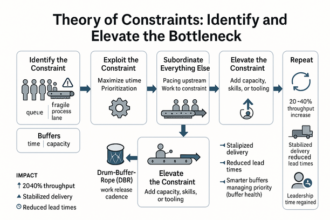
Stalled growth isn’t about total capacity; it’s about a single constraint. The Theory of Constraints (TOC) uses five focusing steps to create a repeatable rhythm that adds 20–40% throughput with minimal spend.
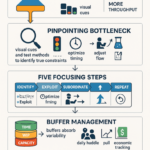
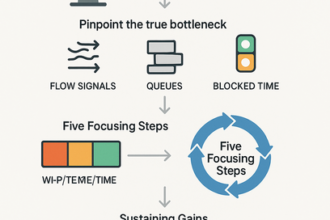
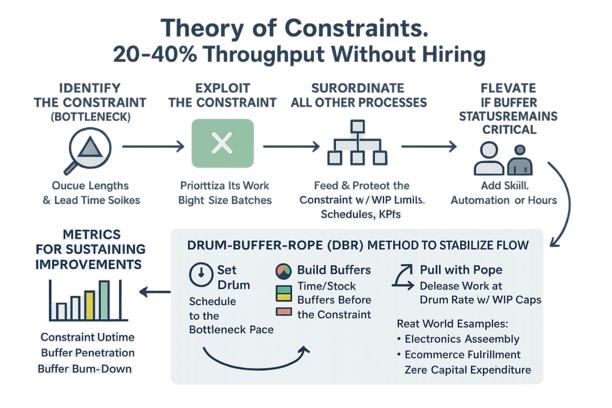
Find the constraint by where work queues and due dates slip; measure flow, not activity. Exploit it: maximize uptime, right-fit batches, and decouple rework. Subordinate everything else to feed and protect it. Elevate if the buffer stays red; then repeat as the constraint shifts.
- Identify the real bottleneck via queue length and lead‑time spikes—often a release‑approval queue, not engineering.
- Exploit it: prioritize its work, right‑size batches, and buffer with time/stock/capacity to absorb variability.
- Subordinate the rest: work‑in‑process (WIP) caps, schedules, and key performance indicators (KPIs) keep the constraint continuously fed.
- Elevate after stability—add skill, automation, or hours—then repeat as the constraint moves.
This focus cuts firefighting and lead times quickly. For a quieter path, the Lyaxis weekly note shares practical playbooks and metrics you can use tomorrow—see the newsletter archive at Lyaxis Newsletter.
Buffer Management and Drum-Buffer-Rope: Stabilizing Flow and Cutting Lead Times
Growth stalls when flow breaks. Buffer Management and Drum‑Buffer‑Rope (DBR) let the constraint set the beat, absorb variability, and cut lead times.
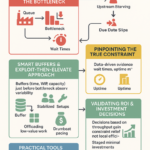
- Set the Drum: find the real bottleneck by queue time; schedule to its rate.
- Build Buffers: place small time or stock buffers before the constraint; act when they go yellow/red.
- Pull with the Rope: release at the Drum rate and cap WIP; avoid flooding downstream steps.
Run the day by buffer health and due dates—20–40% gains are common. DBR aligns start times with the constraint’s pace, while buffers absorb normal variability so the bottleneck never starves. Work‑in‑process (WIP) limits prevent hidden queues from forming and keep lead times predictable.
Applying TOC in Practice: Real-World Example and Hard Numbers That Inspire Confidence
When growth stalls despite effort, the constraint—not the team—is the limit. TOC focuses improvement where it moves throughput.
Case: 120‑person electronics assembler. The reflow oven became the Drum; a 90‑minute time buffer stabilized flow.
- Results: Throughput +32% (2.4k→3.2k/week) with zero capital expenditure; On‑Time In‑Full (OTIF) 82%→96%; lead time 12→7 days; margin +3.8 points.
- What changed: Exploit then elevate—dedicated oven tech; changeovers reduced 9→4 minutes; DBR scheduling; buffer alerts drove daily priorities.
- How to replicate: Set buffers from variability (90th‑percentile “P90” cycle time × 1.5); track constraint uptime and buffer penetration (percent of buffer consumed); review the five focusing steps weekly.
Example: ecommerce fulfillment. Treating the pack station as the constraint, the team rebalanced labor and added a 2‑hour time buffer. Orders rose 28% in two weeks with zero capital spend, and due‑date slips disappeared.
Making TOC Stick: Using Impruver and Constraint-Centric Metrics to Sustain Gains
Growth stalls when effort scales faster than flow. TOC makes improvements compound by steering every day around the single constraint—and by measuring what actually protects it.
Instrument the five focusing steps with constraint‑centric metrics: constraint uptime, buffer penetration, and a buffer burn‑down. Align standups, priorities, and WIP limits to buffer status; let local metrics yield to one throughput number. Elevate only when buffers stay green.
Case in brief (direct‑to‑consumer, “DTC” warehouse): Shifting standups to the pick line (the constraint) and guarding a 2‑hour buffer lifted shipped orders 23% in six weeks, with zero hires and 35% shorter lead times.
Want relief, not more tools? The Lyaxis newsletter shares constraint metrics, buffer recipes, and field‑tested DBR plays you can apply tomorrow: Lyaxis Newsletter. Impruver’s TOC playbook and dashboards help operationalize them for a calm, repeatable 20–40% throughput lift.