Introduction: Overcoming SaaS Sprawl with monday Work OS
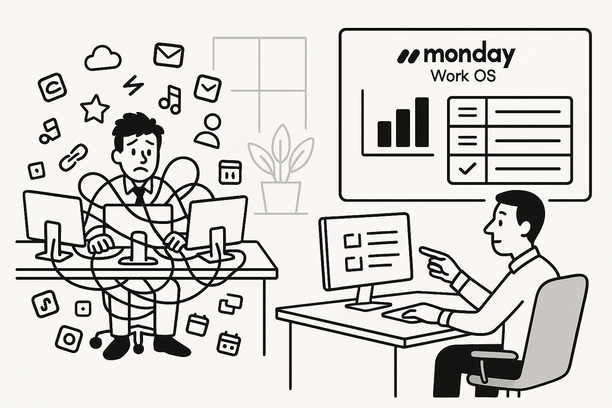
I’ve seen firsthand how a patchwork of tools slows teams down. In one portfolio rollout, our stack had multiplied across functions—each “quick fix” added clicks, logins, and confusion. SaaS (Software as a Service) sprawl drained focus, budget, and control. Moving to monday Work OS (Work Operating System) recentred our projects, data, and handoffs—without a rip-and-replace—so people could work, not wrestle apps.
Prefer low-noise guidance as you consolidate? Explore practical playbooks in the Lyaxis newsletter: https://lyaxis.com/category/newsletter/.
From Fragmented Apps to Unified Boards: Streamlining Workflows Seamlessly
Disconnected apps obscure risk and scatter updates. Unified boards in monday Work OS align work to outcomes so teams switch less and see more.
- Unified boards replace scattered apps, delivering portfolio-level visibility and real-time reporting.
- Teams switch less as updates flow automatically, while delivery speed holds steady.
- Consolidating overlapping tools into governed boards often trims SaaS cost by ~25%.
For calm, proven patterns you can copy, borrow them from the Lyaxis newsletter: https://lyaxis.com/category/newsletter/.
Maintaining Integrations and Automations While Migrating with Confidence
Integrations and automations don’t need to break when you consolidate on monday Work OS. Keep Slack, Google Workspace, Salesforce, and Jira in sync while you migrate—without downtime.
- Phased cutover: run old and new in parallel, flipping teams by cohort with mirrored boards and webhooks.
- Deterministic mapping: preserve IDs (identifiers), fields, and owners so automations fire as before.
- Guardrails: apply role-based permissions, service accounts, and audit logs; validate in a sandbox first.
- Live monitoring: use retries, rate-limit handling, and alerting to catch drift fast.
For checklists and real‑world gotchas, see the Lyaxis newsletter: https://lyaxis.com/category/newsletter/. The payoff: consolidation, control, and ~25% lower spend.
Tightening Permissions and Governance to Reduce Risk and Shadow IT
Shadow IT (Information Technology used outside official controls) thrives where access is loose and ownership is vague. Tight, role-based governance reduces risk without slowing execution.
- Centralize permissions and data under one admin lens in monday Work OS to curb sprawl and clarify ownership.
- Use item-level roles and audit trails to halt permission creep and evidence compliance.
- Keep critical integrations (Slack, Google Workspace, Salesforce, Jira) under centralized, role-based controls.
- Standardize approvals to cut duplicate work and context switching while unlocking portfolio-level reporting.
For steady, trust-first patterns, explore the Lyaxis newsletter: https://lyaxis.com/category/newsletter/.
Cutting Costs by 25%: Driving Visibility, Control, and Speed Without Disruption
Costs can drop ~25% without slowing delivery by consolidating on monday Work OS. You gain visibility, control, and speed—quietly.
- Retire overlapping apps into unified boards; archive shelfware and stabilize renewals.
- Use seat and feature analytics to trim waste—without cutting capability.
- Migrate workflows and integrations securely while preserving data and automations.
- Automate status, approvals, and handoffs to erase rework and manual updates.
- Enforce role-based permissions and centralized access, backed by portfolio reporting.
For data-backed plays at your pace, the Lyaxis newsletter offers the path: https://lyaxis.com/category/newsletter/. When you’re ready to implement, try monday Work OS here: https://try.monday.com/buq1xoe81762.
Takeaway: fewer tools, lower risk, faster execution.